


Every week I analyze a company’s fundamentals as part of my research work. My goal is to understand what drives their consistent performance. This is an educational post to understand the business and not a recommendation to buy the stock.
This week, Let’s explore the business & fundamentals of Swaraj Engines Ltd (SWARAJENG).
Performance Chart
Quality Chart
Their Road to Consistency
1. Overview and Business Model
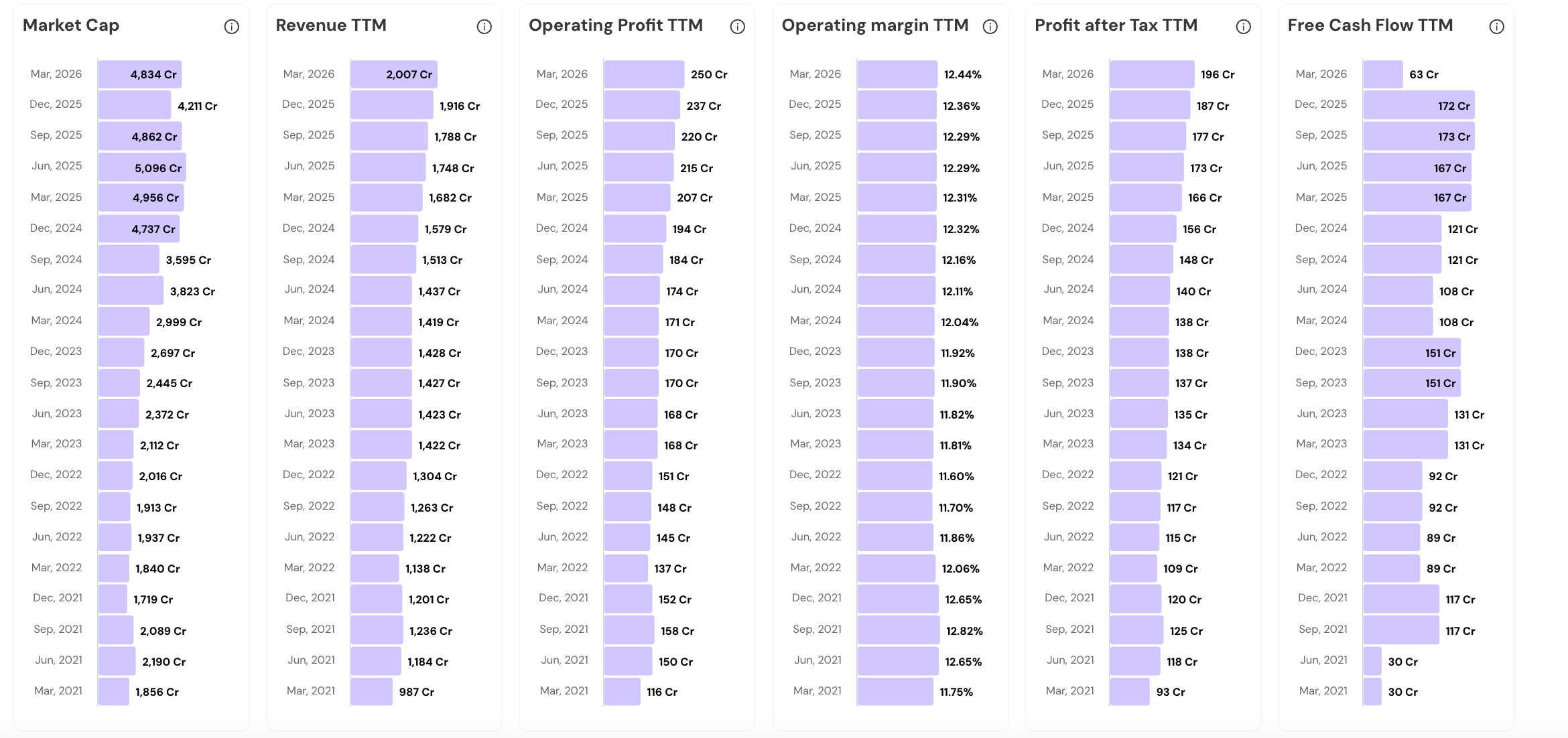
Swaraj Engines Limited was set up in 1985 in Mohali, Punjab. It makes diesel engines exclusively for the Swaraj Division of Mahindra and Mahindra. In FY26, the company crossed ₹2,000 crore in revenue for the first time.
Founded in 1985 as a joint venture between Punjab Tractors and Kirloskar Oil Engines, the company has supplied over 1.76 million engines since inception.
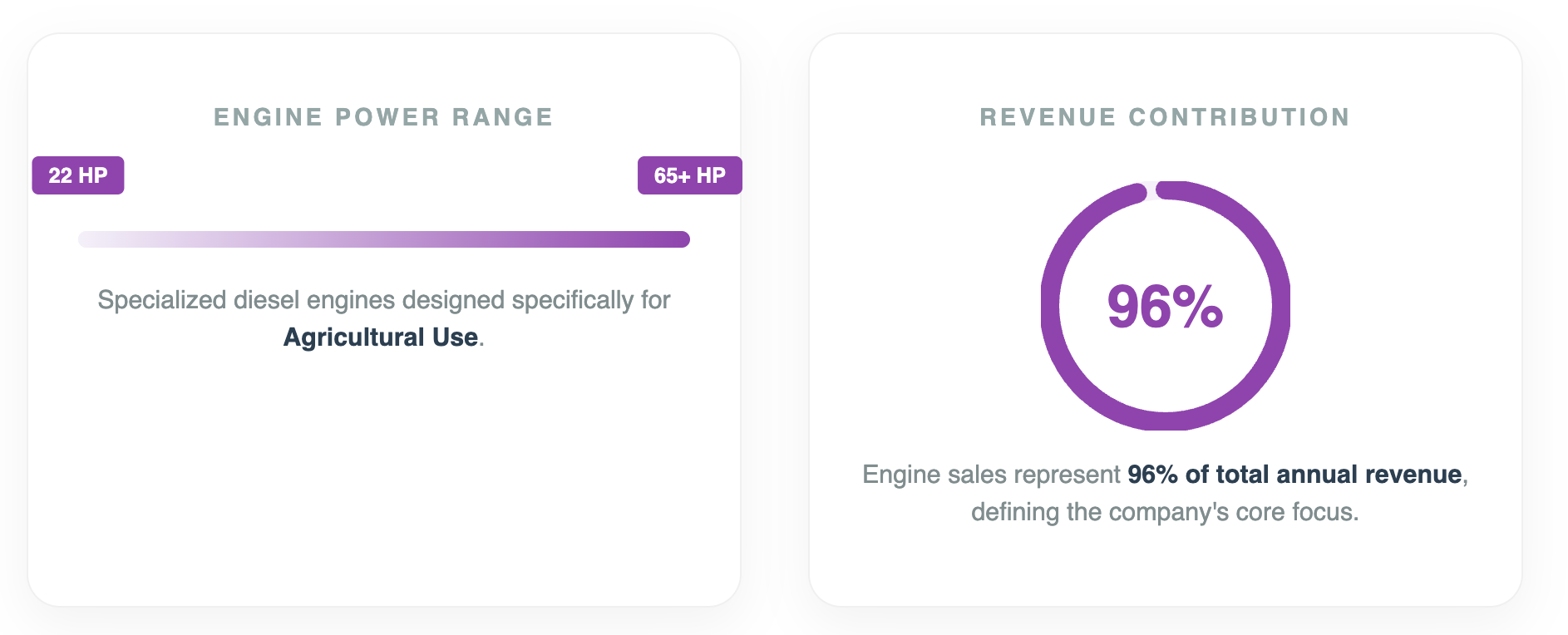
The company manufactures diesel engines ranging from 22 HP to 65-plus HP for agricultural use. Engine sales contribute 96% of total annual revenue.
Approximately 90% of all engines go to the Swaraj Division of Mahindra and Mahindra. One customer defines the business. That concentration is both the strength and the risk.
In FY26, total engine sales volume crossed 2,00,000 units for the first time, reaching 2,02,771 units.
The company also makes cylinder blocks, cylinder heads, and other components for Swaraj Mazda commercial vehicles. Spare parts add a recurring, low-volatility income stream.
Mahindra and Mahindra holds a 52.13% controlling stake since September 2022.
The Mohali plant in Phase IX of the Industrial Focal Point is physically adjacent to Mahindra’s Swaraj tractor assembly line.
Q4 FY26 delivered the highest-ever quarterly engine volume of 55,004 units and PAT of ₹54.56 crore. The 16th consecutive quarter of year-on-year profit growth.
2. Mahindra’s Captive Engine
In September 2022, Mahindra acquired 17.41% stake from Kirloskar Industries for ₹296 crore, raising its holding to 52.13% and making Swaraj Engines a subsidiary. This single transaction changed the company’s strategic character. Demand is now near-guaranteed.
Before September 2022, Mahindra held only a minority stake. Swaraj Engines was classified as an associate company. After the ₹296 crore acquisition, the relationship became structural.
Mahindra paid a premium to secure its engine supply chain. This signals how strategically critical the Mohali plant is to the Swaraj tractor brand.
Being the in-house engine supplier eliminates competition for orders.
The Swaraj tractor brand recently crossed the 25 lakh cumulative production milestone. Every new Swaraj tractor requires a Swaraj Engine.
Co-developed engineering roadmaps mean Swaraj Engines knows exactly what specifications the next generation of tractors will need. Capital planning becomes much more precise.
Mahindra’s R&D centers support Swaraj Engines in meeting TREM IV and TREM V standards. R&D costs are shared across a ₹1.3 lakh crore group.
Raw material procurement benefits from Mahindra Group’s bulk purchasing power, especially for steel and iron castings. Lower input costs follow from group scale.
3. Growing Before Demand
Swaraj Engines has followed a disciplined capacity expansion model. It grew from 1,50,000 to 1,95,000 units in FY25 and immediately filled that capacity. The board has now approved ₹220 crore for a further expansion to 2,40,000 units by 2027.
Annual capacity expanded from 1,50,000 to 1,95,000 units in FY25. The company immediately utilized it, selling 1,68,820 units in FY25 and 2,02,771 units in FY26.
FY26 volume of 2,02,771 units already exceeded the 1,95,000 unit capacity ceiling.
The board approved ₹220 crore for the next phase, targeting 2,40,000 units per year by 2027. Not a single rupee will be borrowed for this. Internal cash will fund it fully.
Capital work in progress jumped from ₹4.77 crore in FY25 to ₹54.81 crore in FY26.
Total capex on fixed assets in FY26 reached ₹69.79 crore, nearly three times the FY25 spend of ₹24.46 crore. The investment pace is accelerating.

New plant upgrades include vertical storage and automated assembly tools. These reduce cycle times.
By FY27, the 2,40,000 unit capacity will represent 60% growth over the 1,50,000 units in FY22. The factory is scaling in step with Mahindra’s rural market ambitions.
4. More With Less
Swaraj Engines runs one of the most operationally lean manufacturing businesses in India. Employee costs are just 3.4% of revenue. The company had only 289 full-time employees in FY25. Revenue grew 19.3% in FY26 while headcount stayed flat.
The company had 289 full-time employees in FY25, down from 351 in FY21. Revenue per employee works out to approximately ₹6.94 crore per year.
Employee costs at 3.4% of net revenue stand far below the 8 to 15% norm for Indian auto-ancillary companies.
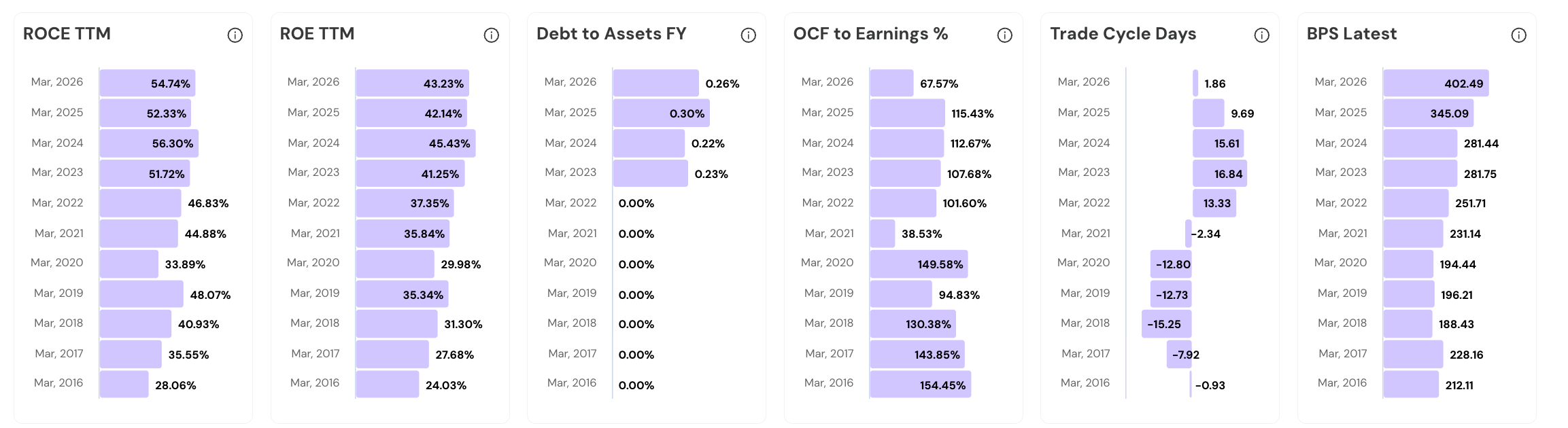
Finance costs in FY26 were just ₹39 lakh for the full year. This covers lease liabilities only. There is no interest burden eroding the PBT line.
Operating profit margins held near 13.5% even through the steel and iron price volatility of 2022 and 2023.
Operating profit before working capital changes was ₹269.17 crore in FY26. PBT was ₹266.98 crore. That is 100% cash conversion.
Revenue grew 19.3% in FY26. Absolute employee costs grew only modestly.
The company runs a single reportable segment: diesel engines and components. No unrelated diversification, no cross-subsidies, no management distraction.
5. Rural India Mechanizes
India’s tractor market reached 9,39,700 units in FY25, growing 7.3% year-on-year. Labor scarcity in agriculture, rising Minimum Support Prices for crops, and improving farm credit are structural tailwinds pushing more farmers toward mechanization. These forces are multi-decade in nature.
The Indian tractor market reached nearly 9.4 lakh units in FY25, up 7.3% from the prior year. The total market value crossed ₹75,000 crore. This is a large and consistently growing pool.
Agricultural labor scarcity is structural, not cyclical. Fewer young people want to do manual farm work. Tractors fill the gap. This creates a demand floor that holds even in softer years.
The Minimum Support Price for wheat and paddy rises almost annually. Higher crop income gives farmers both the surplus and the confidence to buy new tractors.
The 41 to 50 HP segment accounts for roughly 50% of all tractor sales in India. Swaraj Engines dominates this exact range with engines for the Swaraj 744 FE and similar models.
Agricultural credit disbursal from nationalized banks and NBFCs has improved. Tractor loans are now accessible to a broader set of farmers. Affordability expansion drives incremental volume.
Horticulture and orchard farming are growing in Punjab, Rajasthan, and Maharashtra. Compact tractors for sub-30 HP applications are gaining share. Swaraj has product offerings in this segment too.
The trend toward higher horsepower is also a revenue lever. A 50 HP engine earns more per unit than a 35 HP unit. As farmers upgrade their equipment, average selling price per engine rises.
Reservoir levels, groundwater data, and state-level rainfall figures are monitored monthly by management. These are genuine leading indicators for the quarterly order book.
6. Regulatory Barriers
India is introducing TREM V emission norms, beginning with tractors above 75 HP and below 25 HP from October 2026. TREM V (Tractor Emission Stage V) norms are the latest environmental regulations in India designed to significantly lower the pollution generated by off-road vehicles like tractors and construction equipment. These norms require advanced fuel injection systems and precision manufacturing.
TREM V norms will require sharply lower soot and nitrogen oxide emissions from tractor engines. Only manufacturers with advanced fuel injection capability and precision casting processes can comply.
For tractors above 50 HP, Swaraj Engines has already completed the transition to TREM IV norms. TREM V is the natural next step.
The 25 to 75 HP segment, which covers the highest-volume tractor category, has until 2032 to adopt TREM V. This runway allows disciplined, planned investment.
The upcoming TREM V transition is expected to raise tractor prices by 15 to 20% in high-volume segments. Pre-norm buying spikes boost near-term volumes. Swaraj Engines benefits on both ends.
The ₹220 crore factory expansion includes specific technology upgrades for TREM V readiness. Compliance investment and capacity investment are combined into one project.
Mahindra Group R&D centers share the cost of developing clean-air engines. This advantage is not available to standalone engine makers.
Swaraj Engines is also evaluating CNG as an alternative agricultural fuel for the future. This forward-looking exploration ensures the company does not become irrelevant in a post-diesel transition.
7. Built in Punjab
The Mohali plant has operated since 1985, embedded in India’s most important agricultural-industrial cluster. This location offers proximity to Mahindra’s assembly line, a technically skilled regional workforce, hundreds of specialized local vendors, and 40 years of accumulated process knowledge.
The Mohali plant sits inside Phase IX of the Industrial Focal Point, physically adjacent to the Swaraj tractor assembly lines. Moving engines a short distance cuts logistics cost and delivery time.
Punjab was the epicenter of India’s Green Revolution. The regional workforce carries decades of mechanical and agricultural engineering experience.
The local vendor ecosystem supplies specialized bolts, valves, gaskets, and precision castings. These relationships have deepened over 40 years. Replicating this network elsewhere takes decades.
Industrial investment in Punjab is expected to reach ₹1.50 lakh crore by 2025. Improved roads, power supply, and logistics infrastructure benefit the Mohali plant.
The CSR initiative Project Pani focuses on water conservation in Punjab and Rajasthan. This maintains goodwill with the farming communities who are the end-users of the engines.
The company has operated without any major labor strikes or production disruptions since 1985. Four decades of stable industrial relations in one location is an undervalued competitive advantage.
Hiring preferences favor candidates from farming families. Workers who grew up on farms understand how engines perform under real field conditions.
The third expansion of the Mohali plant, targeting 2,40,000 units, deepens the commitment to this exact location.
8. Risks & Red Flags
Nearly 90% of revenue comes from one entity: the Swaraj Division of Mahindra and Mahindra. If Mahindra ever decides to build engines in-house or shifts strategy, the impact would be catastrophic. This is the single biggest risk.
The tractor market is deeply monsoon-dependent. FY24 saw volumes decline 7% due to erratic rainfall. Two consecutive bad monsoon years would materially compress Swaraj Engines’ volumes, revenue, and margins simultaneously.
All production sits in a single Mohali facility. Any natural disaster, extended power outage, or labor stoppage would shut down 100% of capacity. Geographic concentration amplifies operational risk significantly.
Trade receivables rose from ₹177.22 crore in FY25 to ₹206.18 crore in FY26. Revenue grew 19.3% but receivables grew at a similar pace.
TREM V compliance requires continued capital investment beyond the ₹220 crore project. If implementation timelines shift or cost estimates run over, the cash position that makes this business look bulletproof could come under pressure.
That’s it for today.
FINVEZTO.COM | Build Wealth. With Clarity.
Disclaimer: Anand Ganapathy K is a SEBI-registered Research Analyst with SEBI registration number INH000016630. This post is purely for learning purposes. I do not recommend buying or selling stocks mentioned in this newsletter. I do not hold any positions in the stock discussed. Securities market investments carry market risks. Kindly review all related documents before investing.