


Each week I analyze one company's fundamentals as part of my research work. My goal is to understand what drives their consistent performance. This is an educational post to understand the business and not a recommendation to buy the stock.This week, Let’s explore the business & fundamentals of SUBROS Ltd.
In the last 5 years…

- Stock price has grown 2.5 times (from 343.15 to 864.97)
- Revenue has grown 2.3 times (from 1,584 Cr to 3,614 Cr)
- Operating profit has surged 4.7 times (from 41 Cr to 191 Cr)
- PAT has surged 4.0 times (from 38 Cr to 153 Cr)

Take a look at the chart below.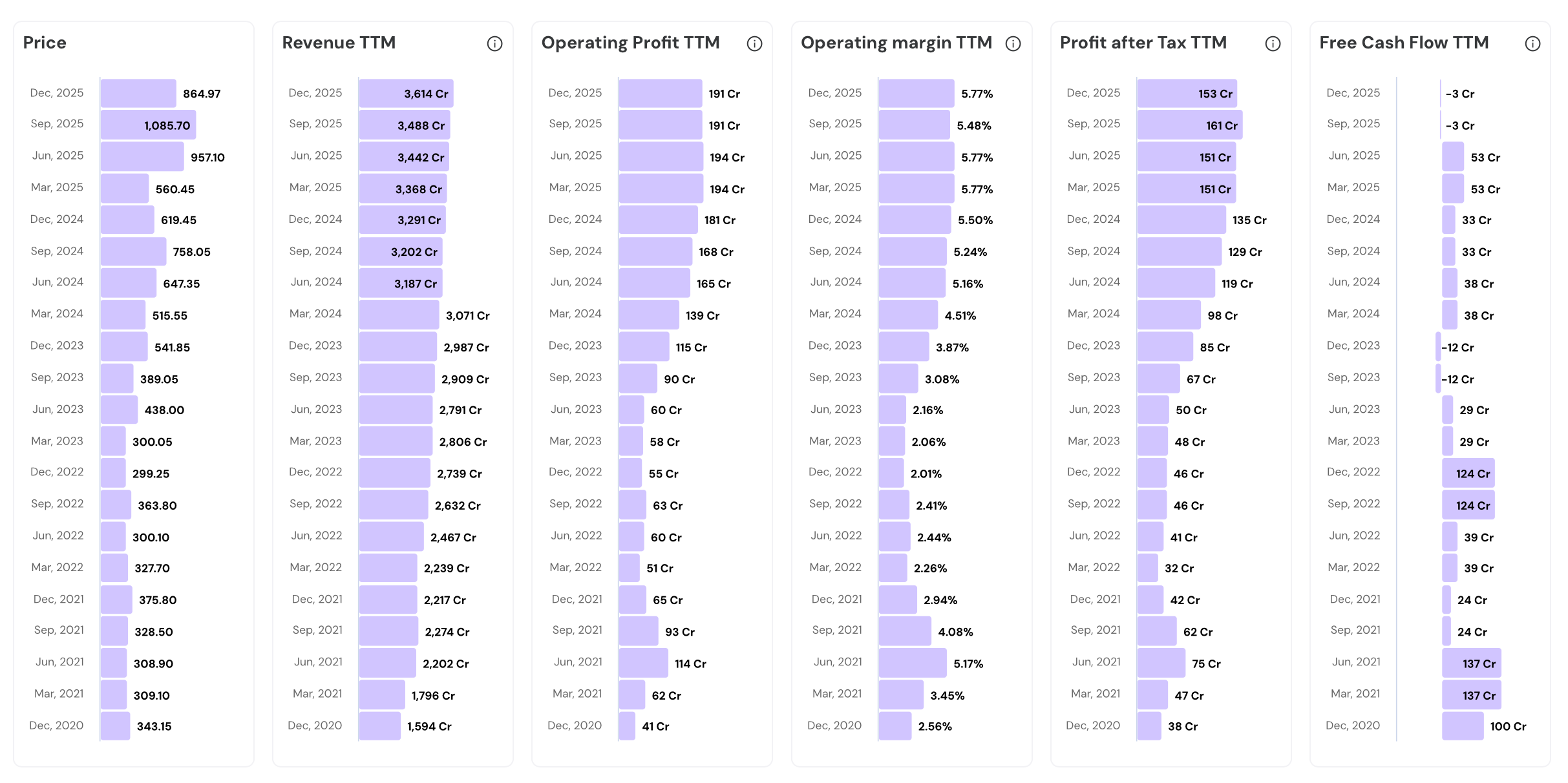
They have also been reducing their debt and improving their Return on Capital over the years.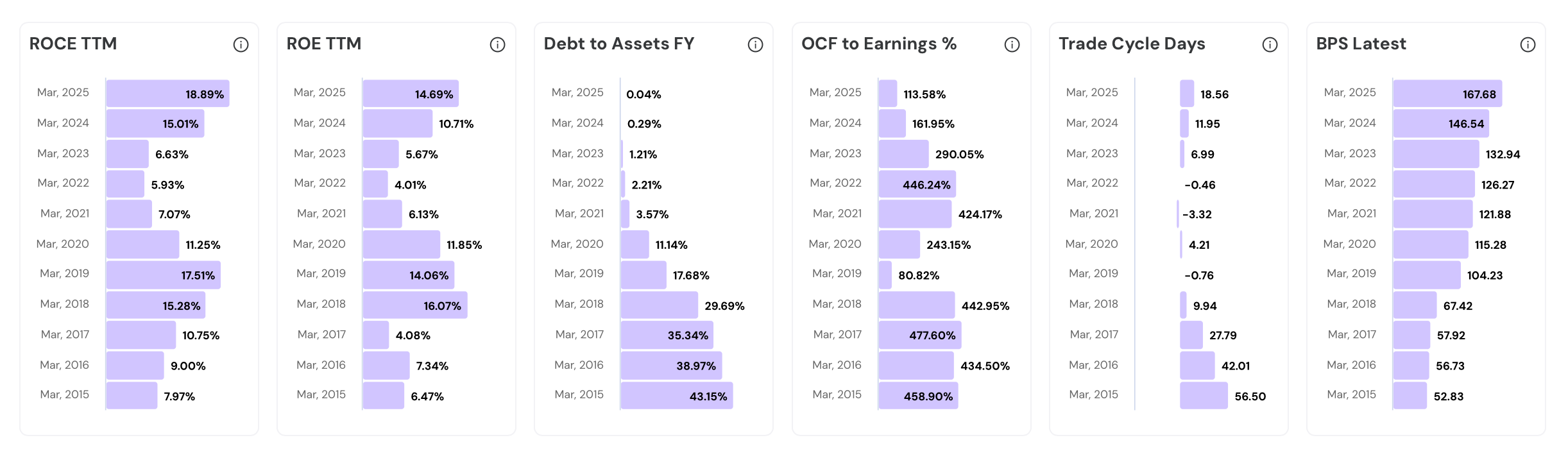
Their Road to Consistency
1. SUBROS Business Model
Subros manufactures the complete thermal ecosystem for automobiles: compressors, HVAC units, condensers, evaporators, heat exchangers, radiators, and hose assemblies. Subros designs and produces the entire climate control loop that vehicles depend on for passenger comfort & thermal management.
Founded in 1985 as a tripartite joint venture with 3 strategic anchors:
the Suri family holds 36.79%,
Denso Corporation 20%, and
Suzuki Motor Corporation 11.96%.
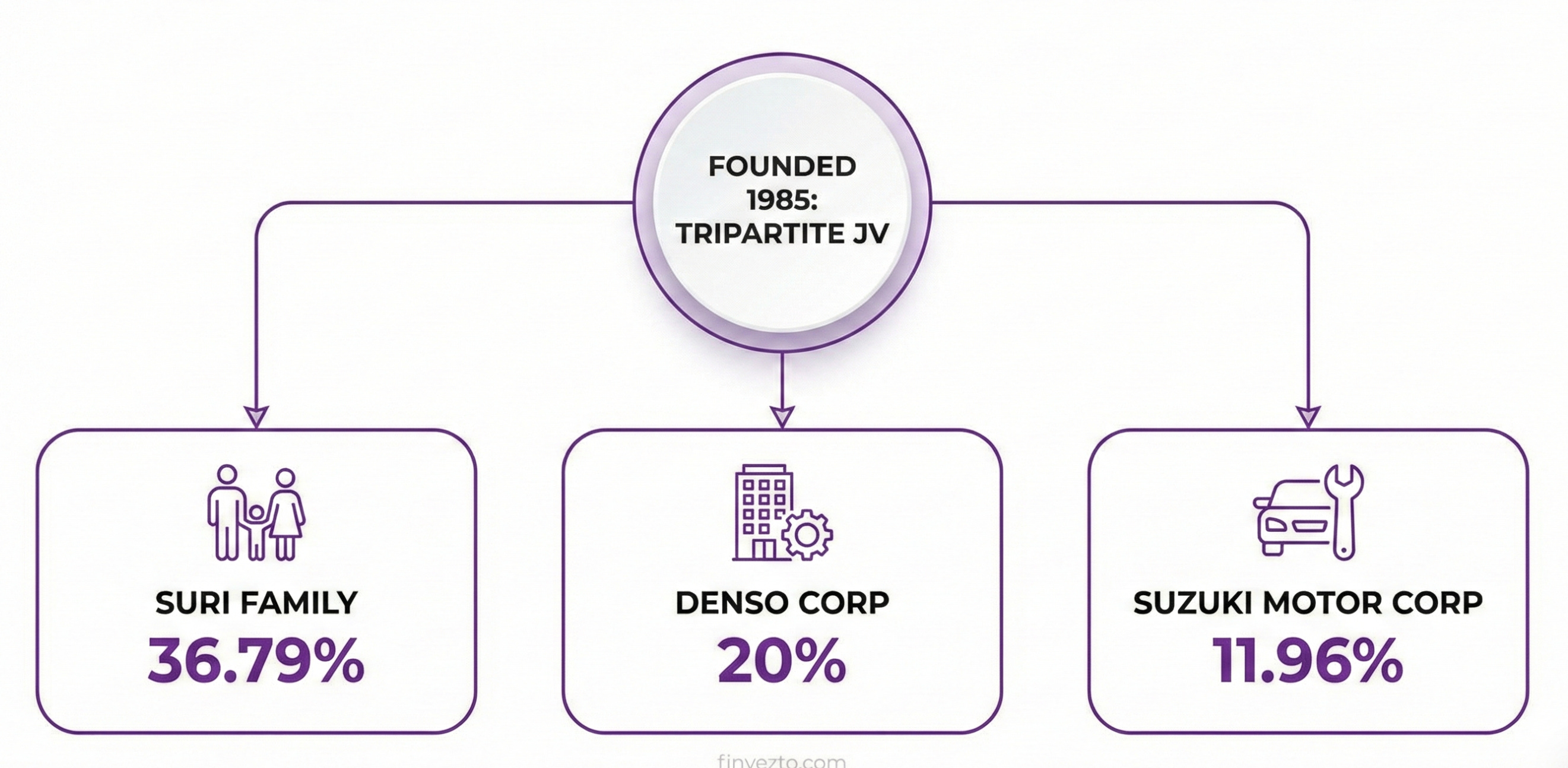
This ownership triangle ensures operational control, technology access, and customer captivity simultaneously.
SUBROS operates as a Tier-1 OEM supplier, selling directly to vehicle manufacturers rather than through aftermarket channels. This positioning locks Subros into multi-year platform contracts.
Revenue composition tilts heavily toward passenger vehicle AC systems at approximately 93%, with the remaining 7% split across commercial vehicles, Indian Railways, transport refrigeration, and home AC.
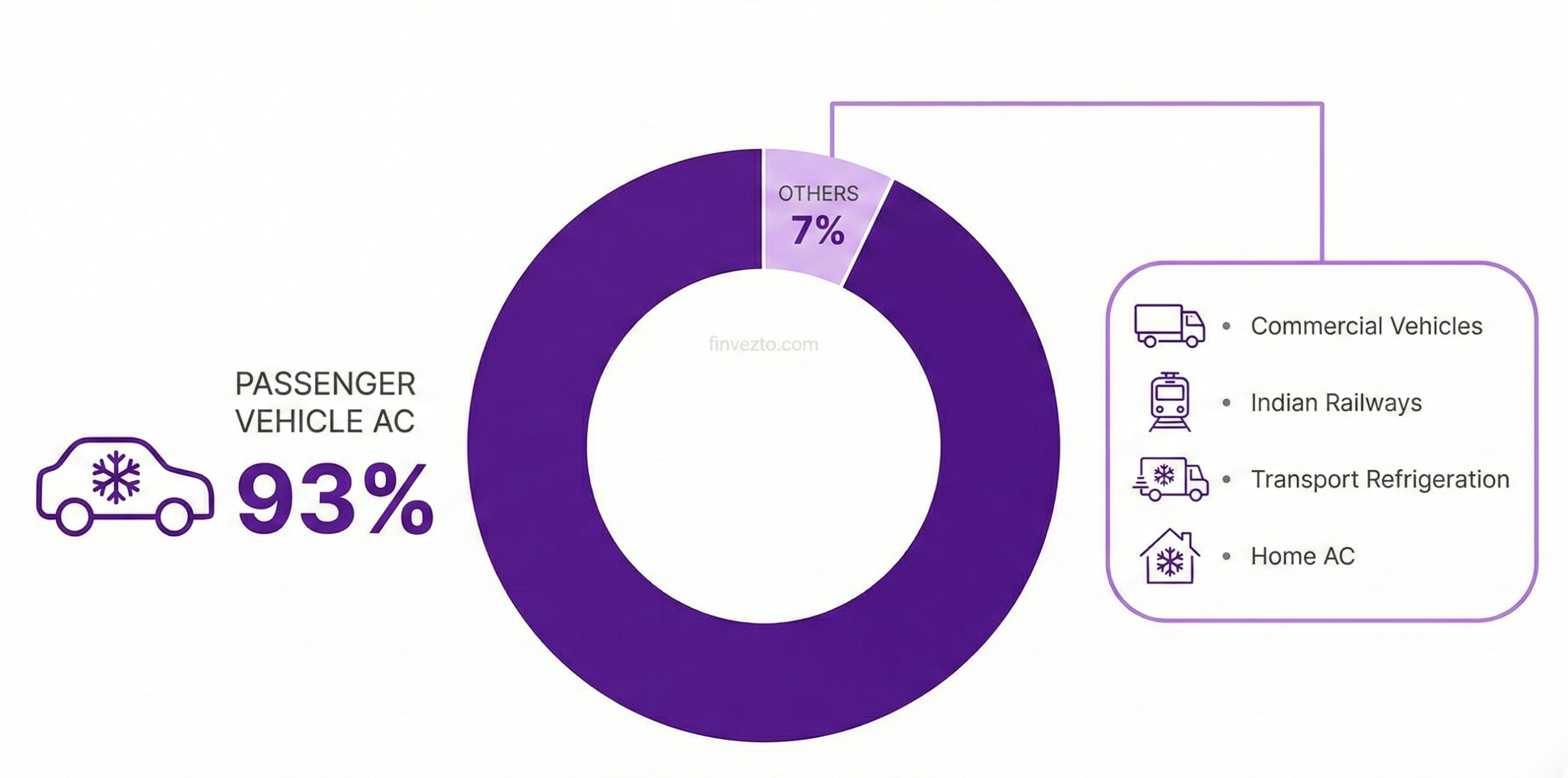
Subros commands ~45% market share in the passenger car AC segment. This means nearly half of all cars sold in India are cooled by a Subros system. In the truck air-conditioning and blower segment, Subros is even more dominant, holding ~50% market share.
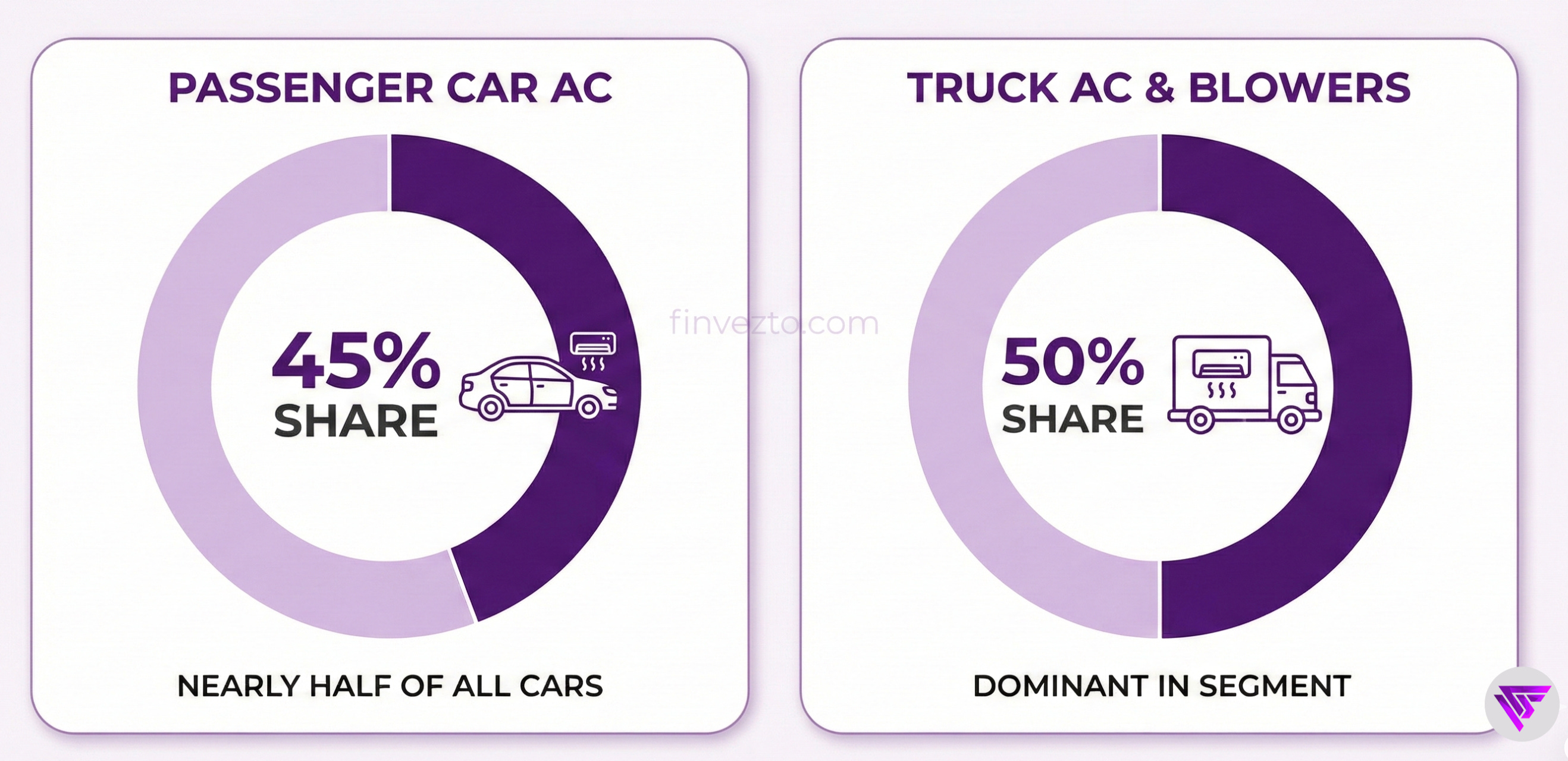
The consistency & leadership of Subros stems from this embedded nature. It is harder to remove Subros from a Maruti car than it is to change the tyre supplier.
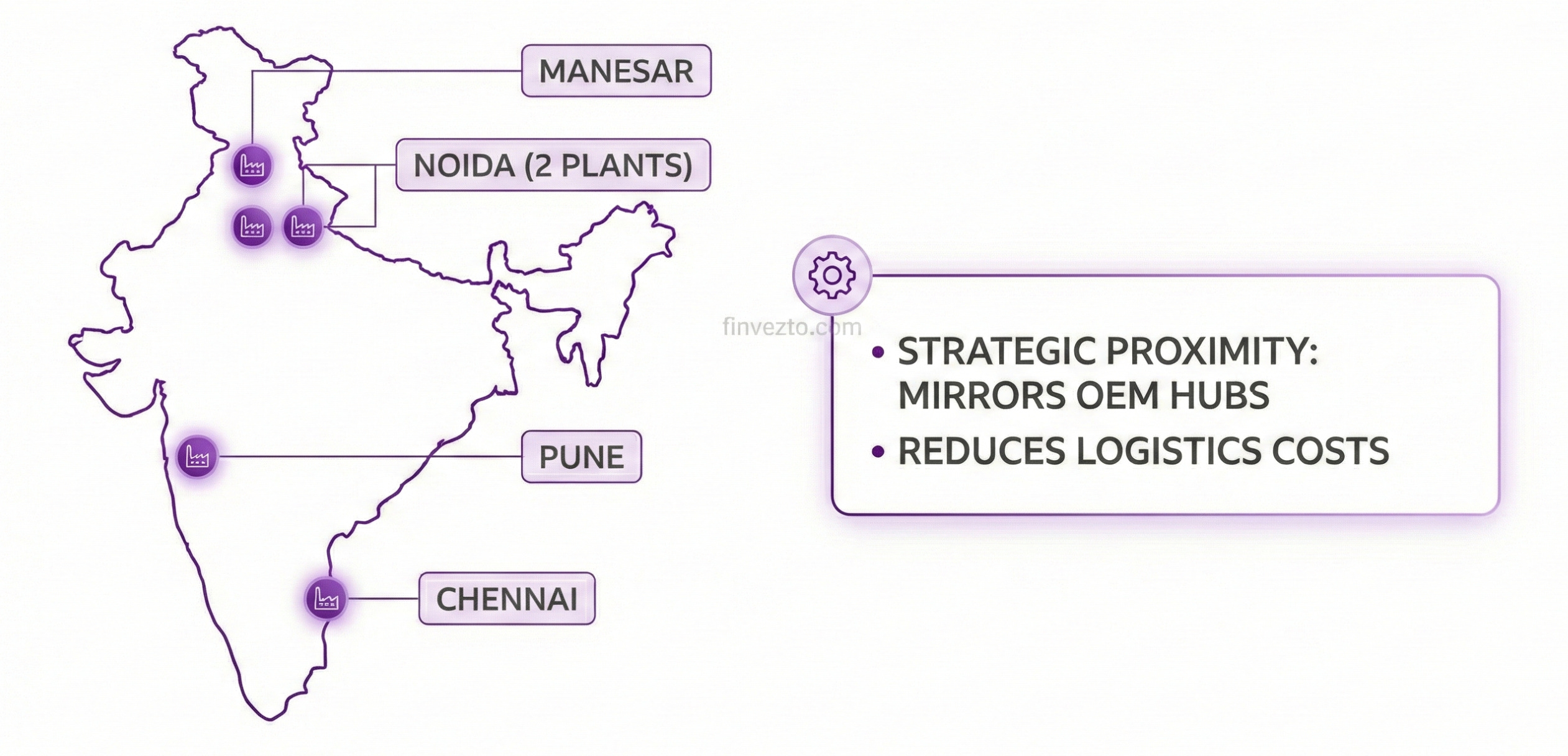
Subros operates 7 manufacturing plants across India. 2 in Noida, and 1 each in Manesar, Pune, Chennai, Nalagarh, and Karsanpura. These locations represent the automotive manufacturing hubs of major OEM customers maintaining proximity.
2. EV Thermal Content Multiplier
This is the single most transformative growth driver.
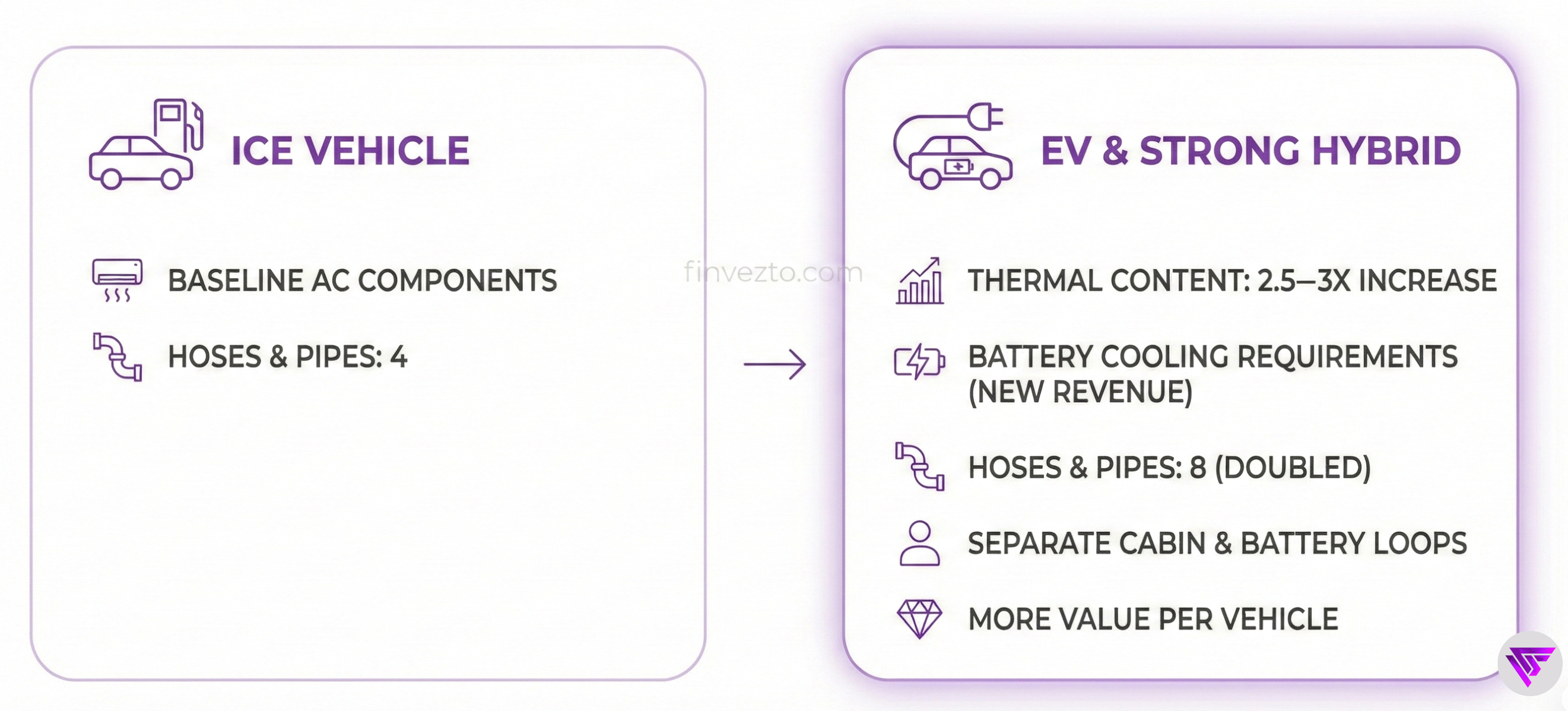
In an ICE vehicle, Subros supplies baseline AC components. But in an EV or strong hybrid, thermal content per vehicle increases 2.5 to 3x. Battery cooling requirements create entirely new revenue streams.
Hose and pipe requirements double from 4 in ICE vehicles to 8 in EVs due to separate cooling loops for cabin and battery. More value captured per vehicle.
The electric compressor alone is worth roughly 3x the value of a conventional belt-driven compressor due to integrated motor and inverter technology. This enables premium pricing.
In Jan 2026, Subros secured a ₹1,280 crore order from Maruti Suzuki for locally manufactured electric compressors over a 7-year lifecycle. This single order equals 38% of FY25 revenue.
Subros is receiving technology transfer from both Denso Corporation and Toyota Industries Corporation for electric compressor localization.
The company is investing ₹265 crore in Karsanpura expansion to add 400,000 electric compressors and 500,000 ICE compressors per year capacity. They are building for the hybrid transition.
Currently, Subros supplies EV thermal components for both Maruti’s e-Vitara and Mahindra’s BEV lineup.
3. Mandatory Truck AC Regulation
The Government of India mandated AC-fitted cabins for all new N2/N3 category trucks (gross vehicle weight above 3.5 tonnes) manufactured after October 2025.
This regulatory change creates an entirely new ₹450 crore total addressable market where none existed before October 2025.
AC penetration in trucks will move toward 100% as the mandate becomes enforceable.
Subros has already booked ₹150 crore in truck AC orders and holds a 43-54% market share in the truck AC/blower segment.
Truck ACs require heavy-duty condensers and high-capacity blowers to withstand intense vibration, dust, and 12-18 hour daily operation. This is significantly different from passenger vehicle ACs, as it requires engineering for harsh conditions.
Subros already works with Tata Motors, Ashok Leyland, Mahindra, Daimler, and SML Isuzu on truck AC integration for this mandate. They have established relationships that help in accelerating market capture.
Fleet operators’ primary concern is fuel efficiency. Subros engineers efficient compressors minimizing engine load to address adoption resistance.
This AC-Cabin mandate is statutory, not dependent on consumer sentiment or economic cycles. This provides non-cyclical revenue stream.
With over 50% existing market share, Subros is well positioned to capture majority of this new value creation through FY27 and beyond.
4. Aggressive Capacity Expansion
The Kharkhoda greenfield plant (₹150 crore, Phase 1) near Maruti Suzuki’s new factory will commission by Q1 FY27 with 4.5 lakh parts capacity.
The Karsanpura expansion (₹265 crore) will add 400,000 electric compressors and 500,000 ICE compressors per year to handle both technology transitions.
Total FY26 capex guidance stands at approximately ₹270 crore, representing significant expansion investment funded through internal accruals and prudent debt.
Current installed capacity of 2 million AC kits per annum provides a strong base for scaling.
Capacity additions are demand-driven, tied to specific order wins like the ₹1,280 crore Maruti EV compressor contract rather than speculative.
SUBROS has expanded capacity 133x from 15,000 units at founding to 2 million units today, demonstrating consistent execution capability.
5. Customer Diversification Beyond Maruti
Maruti Suzuki currently contributes around 85% of revenue, but Subros has been addressing this systematically.
SUBROS now supplies to Tata Motors, Mahindra & Mahindra (including tractor exports to Japan and US), and Force Motors’ complete bus range. Gradual de-risking.
Subros supplies to Ashok Leyland including a hydrogen fuel cell bus pilot, positioning for next-generation commercial vehicle technologies.
Renault-Nissan and VECV (VE Commercial Vehicles) are active customers, adding European and joint venture OEMs to the portfolio.
Discussions are underway with Hyundai/Kia for EV supply programs, potentially adding India’s second-largest PV manufacturer.
Subros has begun supplying EV thermal components for Mahindra’s BEV lineup.
The company holds 24% wallet share with Mahindra & Mahindra and is targeting expansion as Mahindra’s SUV portfolio (Thar, Scorpio-N, XUV700) scales.
Each new OEM relationship reduces structural concentration risk and provides optionality if Maruti’s market share declines.
Customer concentration will likely remain above 70% for foreseeable future, but the trajectory is clear and consistent. Slow de-risking in progress.
6. Railways Vertical Emergence
From near-zero revenue in FY24, the railways segment has scaled quickly.
FY25 railway revenue reached ₹17 crore (up 35% YoY), and cumulative FY26 railway orders stand at ₹86.35 crore across multiple applications. Explosive growth.
Orders include a ₹52 crore Annual Maintenance Contract for cab HVAC units (3-year period), creating recurring service revenue stream.
A ₹27 crore order from Banaras Locomotive Works for diesel electric locomotive cabin ACs expands the addressable market within railways.
Subros has started bidding for Vande Bharat train HVAC tenders and is developing metro coach AC products.
The progression from driver cabin AC to coach HVAC to Vande Bharat represents systematic market penetration.
The segment is targeted to reach ₹75 crore by FY27, representing 4x growth from FY25 levels in just two years.
Railways modernization focus on AC coaches and driver comfort aligns perfectly with Subros’s thermal management expertise. Leveraging their core competency into a new vertical.
Service revenue from AMC contracts provides earnings visibility and margin stability independent of new equipment sales cycles.
Railways diversification offers different demand cycle from automotive, buffering against auto sector downturns.
7. Denso Technology Partnership & Innovation
The 40-year Denso relationship gives Subros access to world-class thermal technology without bearing the full R&D cost.
For the critical EV transition, Subros receives technology from both Denso Corporation and Toyota Industries Corporation for electric compressor localization.
The DSEC joint venture (Denso’s first product design company outside Japan) provides continuous application engineering support and local customization.
Denso provides virtually all core product design and manufacturing know-how through technical assistance agreements spanning 4 decades.
The partnership allows Subros to stay current with global standards for eco-friendly refrigerants, noise reduction targets, and efficiency norms.
Subros has also developed in-house capabilities too. Engineers authored SAE Technical Paper on smart control logic for EV battery cooling systems.
The company holds multiple Indian patents in compressor-related areas, showing innovation beyond mere technology absorption.
Subros operates a dedicated Tool Engineering Centre to design and manufacture complex molds and dies, reducing dependence on external tool makers.
8. Automatic Climate Control Segment Growth
Automatic AC, or Automatic Climate Control, is an advanced vehicle HVAC system that maintains preset cabin temperature automatically using sensors, actuators, and electronic controls. They do not need constant adjustments like manual AC.
Automatic AC penetration in domestic passenger vehicles has crossed 40% from ~25-30% previously. Almost 90% of export vehicles have auto AC fitment.
The SUV segment where auto AC penetration is highest grew 14.66% in FY25, creating favorable mix shift for Subros.
In FY25, Subros’s passenger Vehicle AC segment grew 8% versus industry growth of just 4%.
Automatic climate control systems require more sensors, actuators, and electronic control units compared to manual ACs, increasing value per vehicle.
The shift from hatchbacks to SUVs requires higher capacity compressors and larger heat exchangers due to bigger cabin volumes. Vehicle size upgrades benefit Subros disproportionately.
Rear AC vents in SUVs require additional ducting, blower capacity, and HVAC complexity compared to front-only systems in hatchbacks.
The premiumization trend is structural, driven by rising disposable incomes and consumer preference for comfort features.
Maruti’s SUV portfolio expansion (Brezza, Grand Vitara, Fronx, Jimny) creates natural content-per-vehicle uplift even within existing customer base.
Content increase per vehicle compounds on top of India’s underlying vehicle volume growth, creating a double growth engine.
9. Management Stability & Governance
Shradha Suri Marwah has served as Managing Director since 2008 and Chairperson since 2021, providing leadership continuity.
CEO Parmod Kumar Duggal drives operational strategy and EV Pivot plans.
The company has maintained a clean governance record with no SEBI penalties, no audit qualifications, no fraud allegations, and zero promoter share pledge.
Promoter holding has remained stable at 36.79% since FY19, demonstrating long-term commitment and Skin in the game.
Board representation from both Suzuki Motor Corporation and Denso Corporation ensures strategic alignment with key stakeholders.
Shradha Suri Marwah served as President of ACMA (Automotive Component Manufacturers Association of India) between 2023-25, reflecting industry stature.
Management has demonstrated consistent execution against stated targets. Margin expansion, capacity additions, and customer diversification are all progressing as guided.
The Suri family has operated the business for 40 years through multiple automotive cycles. They have institutional knowledge. Current Professional management team alongside promoter leadership creates balance.
No related party transaction irregularities or whistleblower complaints. Clean operations.
10. Industry Tailwinds
India’s passenger vehicle industry crossed 5 million units in FY25 providing volume tailwind for all auto component suppliers.
EV sales reached 1.97 million units across categories. The auto components sector is projected to reach US$200 billion by end of FY26.
Subros sits at intersection of rising vehicle volumes, increasing AC penetration, premiumization toward automatic climate control, and EV thermal content multiplication. Multi-layered growth drivers.
11. Risks
Customer concentration remains their single biggest vulnerability.
Maruti Suzuki accounts for approximately 85% of Subros’s revenue, an extreme level of customer concentration creating existential risk. If Maruti falters, Subros suffers disproportionately.
The 40-year relationship and Suzuki’s equity stake provide stability, but investors must recognize this as structural fragility.
Denso provides virtually all core product technology. Subros does not independently design its primary products as DSEC handles design.
If Denso decided to supply Indian OEMs directly through other subsidiaries (Denso Kirloskar already serves Honda/Toyota), Subros would face challenges.
The FY22-FY23 period demonstrated how margins can erode. EBITDA margins dropped from 9.5% to 6.0% as commodity prices surged. Limited ability to pass through costs in real time.
If the EV adoption curve in India is slower than expected, new electric compressor capacity (₹175 crore investment) could sit idle. Technology transition timing risk exists.
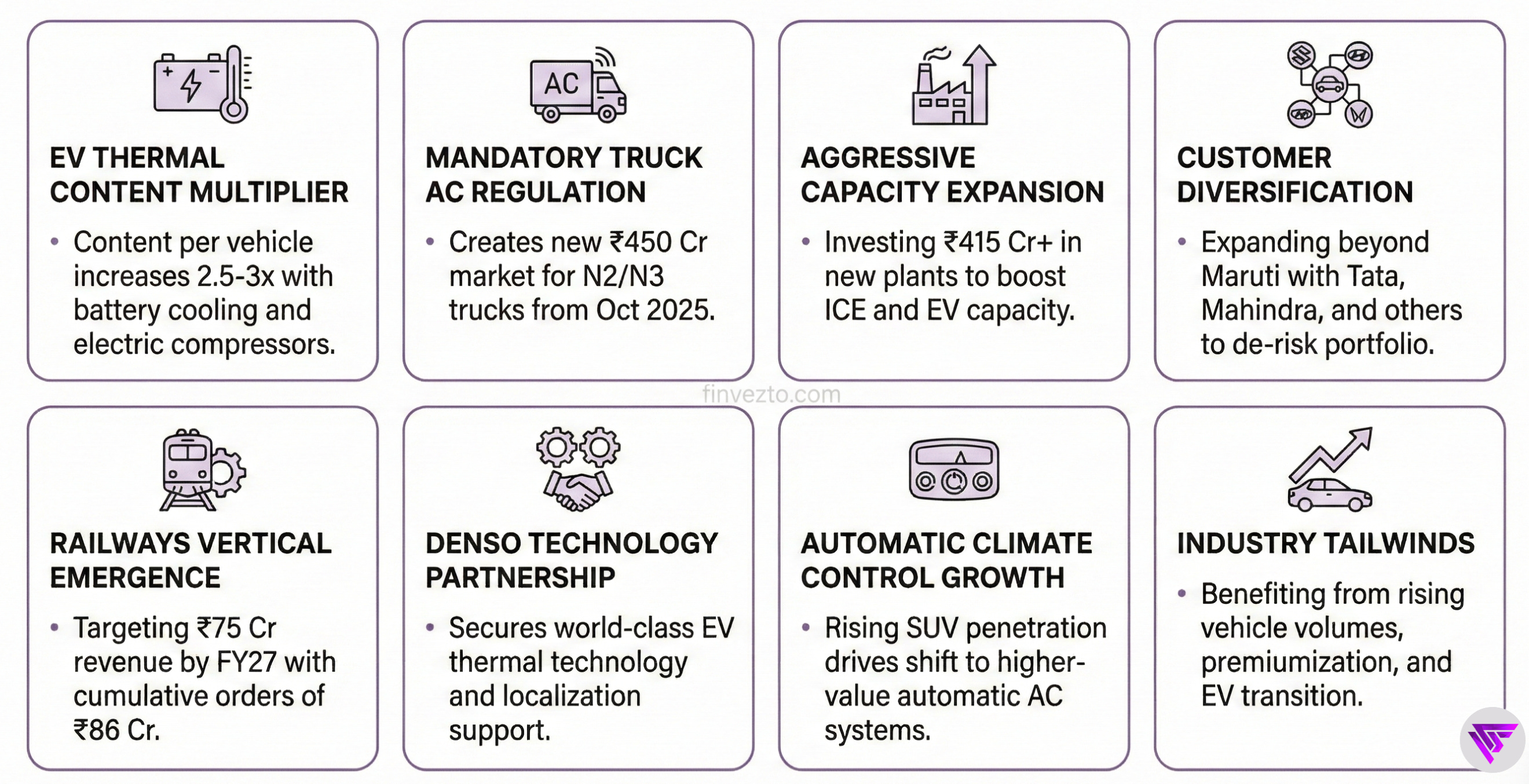
12. Summary: Their Consistency & Growth Drivers
FINVEZTO.COM | Build Wealth. With Clarity.
We give you a proven Flexi-Wealth System to build a Resilient Portfolio that works across market cycles. We believe your Wealth should be flexible enough to give you more options throughout your life. Learn more about the system at finvezto.com


Disclaimer: Anand Ganapathy K is a SEBI-registered Research Analyst with SEBI registration number INH000016630. This post is purely for learning purposes. We do not recommend buying or selling stocks mentioned in this newsletter. Securities market investments carry market risks. Kindly review all related documents before investing.
Good morning sir . Sir plz discuss about swan defence .