


The Indian stock market gives you 20+ different ways to participate. Investing, intraday trading, futures, options buying, scalping, IPOs, arbitrage, and more.
Most retail traders are playing some of these games without ever asking one basic question: Is this a game I can actually win?
This article answers that. I will run each game through a two-filter test, show you which 4 games pass, and explain exactly why the rest are structured against you.
If you prefer watching this as a video, please find the link below. Otherwise, proceed to read this article.
The 20 Games You Can Play
Most Retail participants are playing one of these 20 games.
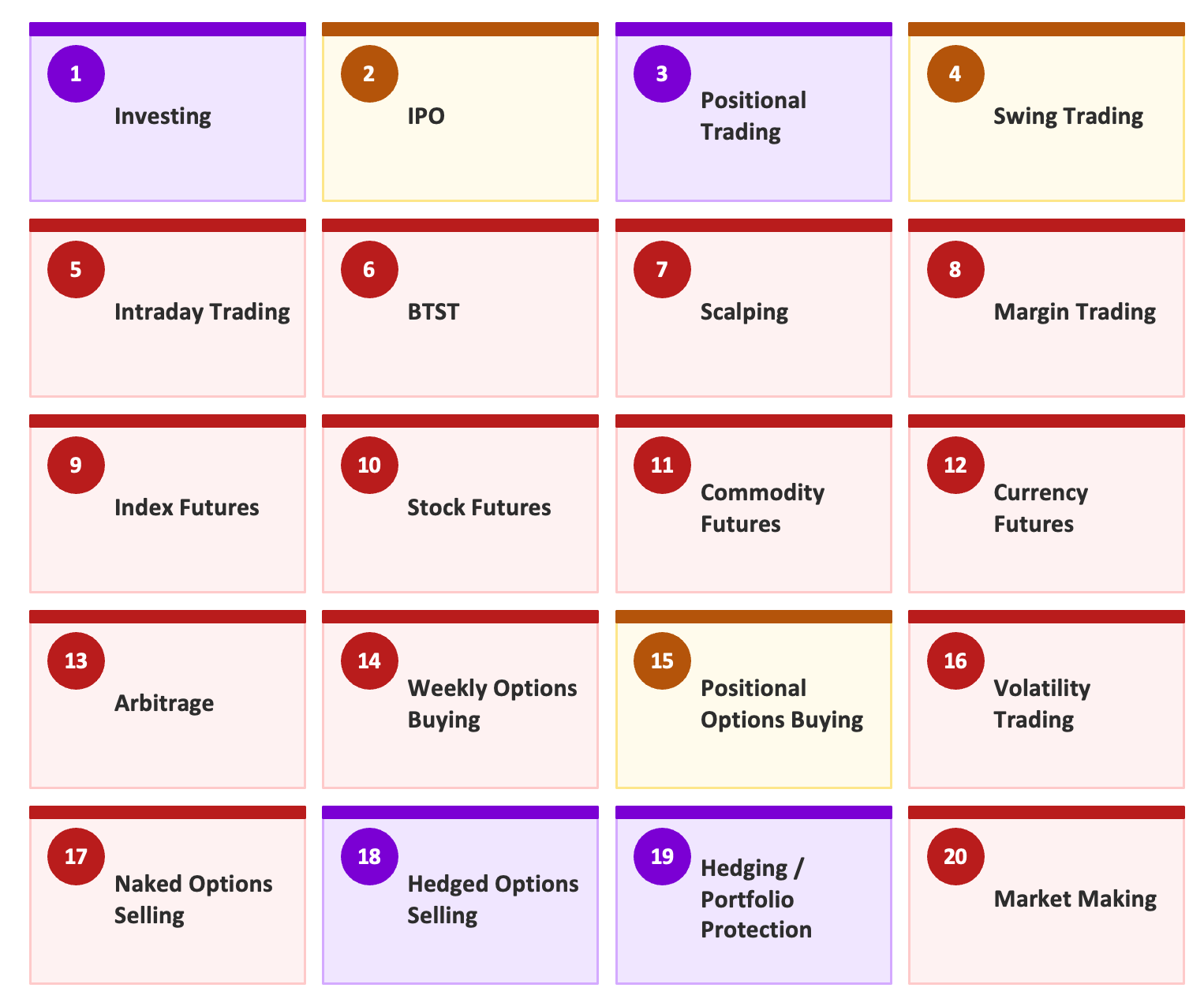
Some of these games have existed for decades. Some are made possible only by modern technology. But not all 20 are equal.
To identify which games you should actually play, you need a filter. Not gut feel. Not what your friend recommends. A proper filter with two hard conditions.
The Two-Filter Test
Every game you consider playing must pass the following two filters.
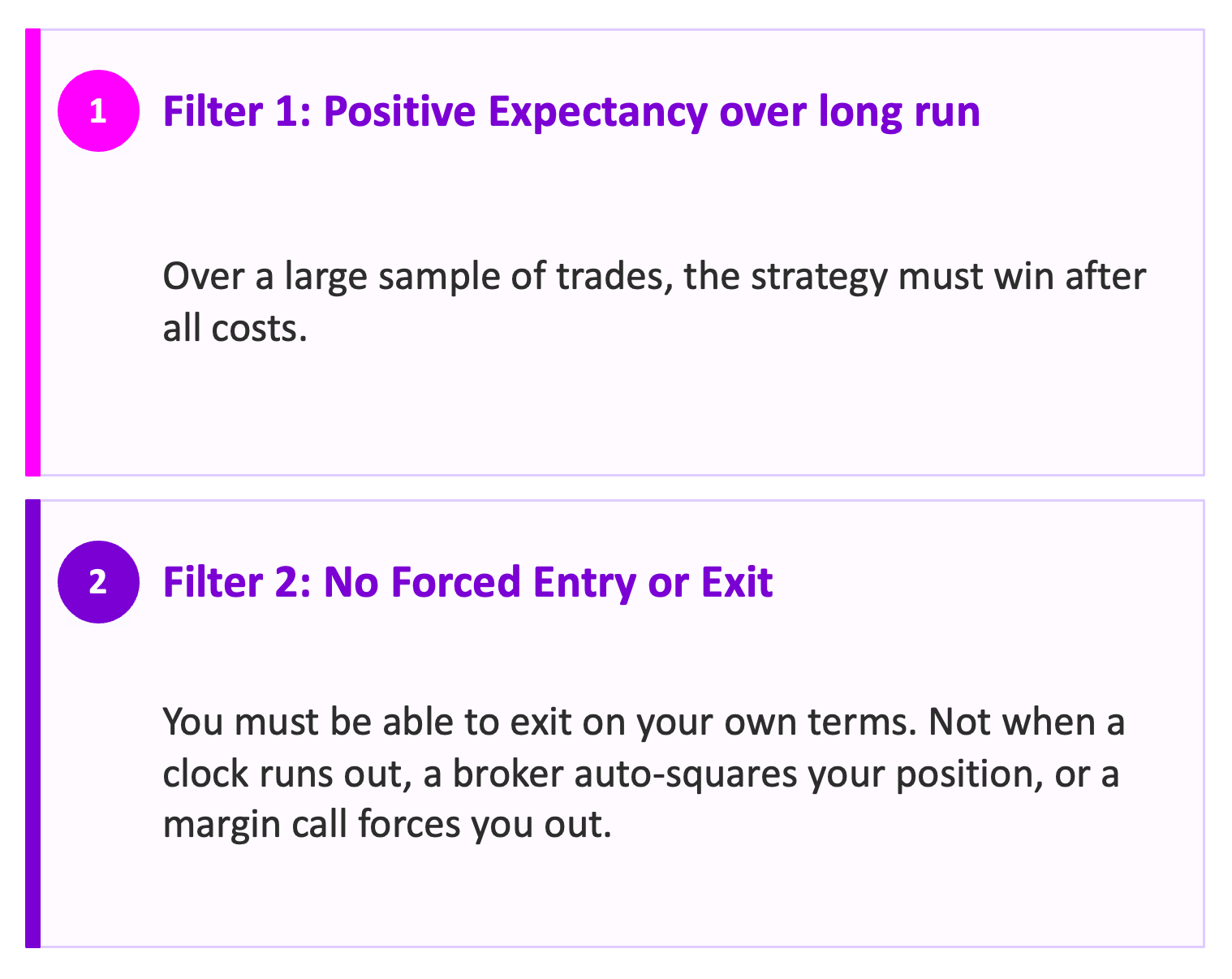
Filter 1 is positive expectancy over the long run. Over a large sample of trades, after accounting for all costs including bid-ask spread, slippage, brokerage, and transaction charges, your strategy must be profitable.
Filter 2 is no forced entry or forced exit. You must be able to exit on your own terms. Not because a clock ran out, not because a broker auto-squared your position at 3:20 PM, not because a margin call wiped you out before your thesis could play out.
Both filters must pass. Miss even one and the game is not for you.
Why Intraday Trading and Scalping Are Weak Hands
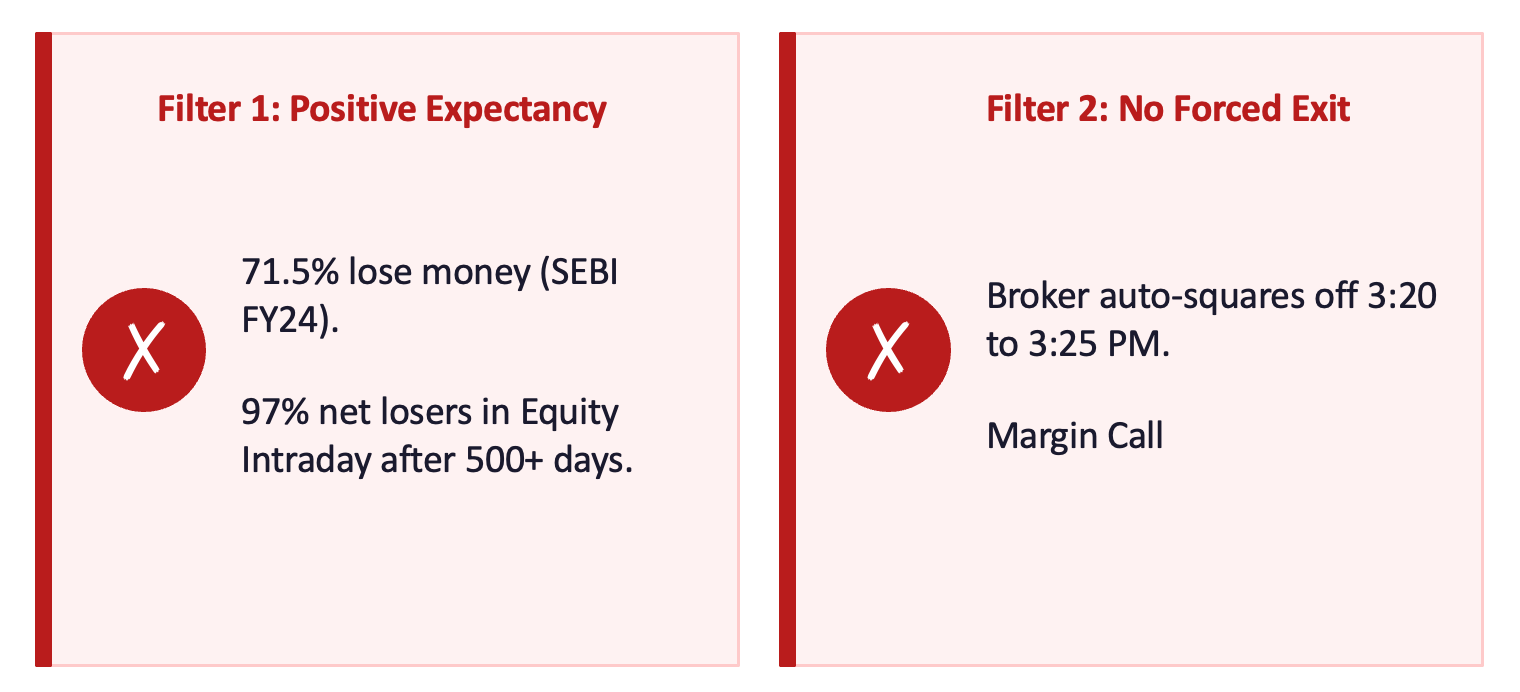
Let us start with the most popular game that retail traders play: intraday equity trading.
Both filters fail here.
On Filter 1, SEBI data for FY24 shows 71.5% of intraday equity traders lost money. Among traders who consistently do intraday trading for 500 days or more, 97% are net losers. The positive expectancy simply does not exist after costs.
The structural reason for this is important to understand. A significant amount of intraday volume on Indian exchanges is executed by algorithms. HFT firms and market makers have sub-millisecond execution and co-location advantages inside the exchange itself. They are physically closer to the matching engine than any retail trader can ever be.
On Filter 2, intraday trading fails completely. Your broker will auto-square off positions between 3:20 and 3:25 PM regardless of whether your trade is in profit or loss. If you are trading futures intraday, a margin call can force you out mid-trade. You have no control over your exit.
You might have a green day occasionally. Over a long run, the expectancy does not hold up and the forced exits make it worse.
Strong Hand #1: Investing
Now for the games you should actually play.
Investing passes both filters cleanly.
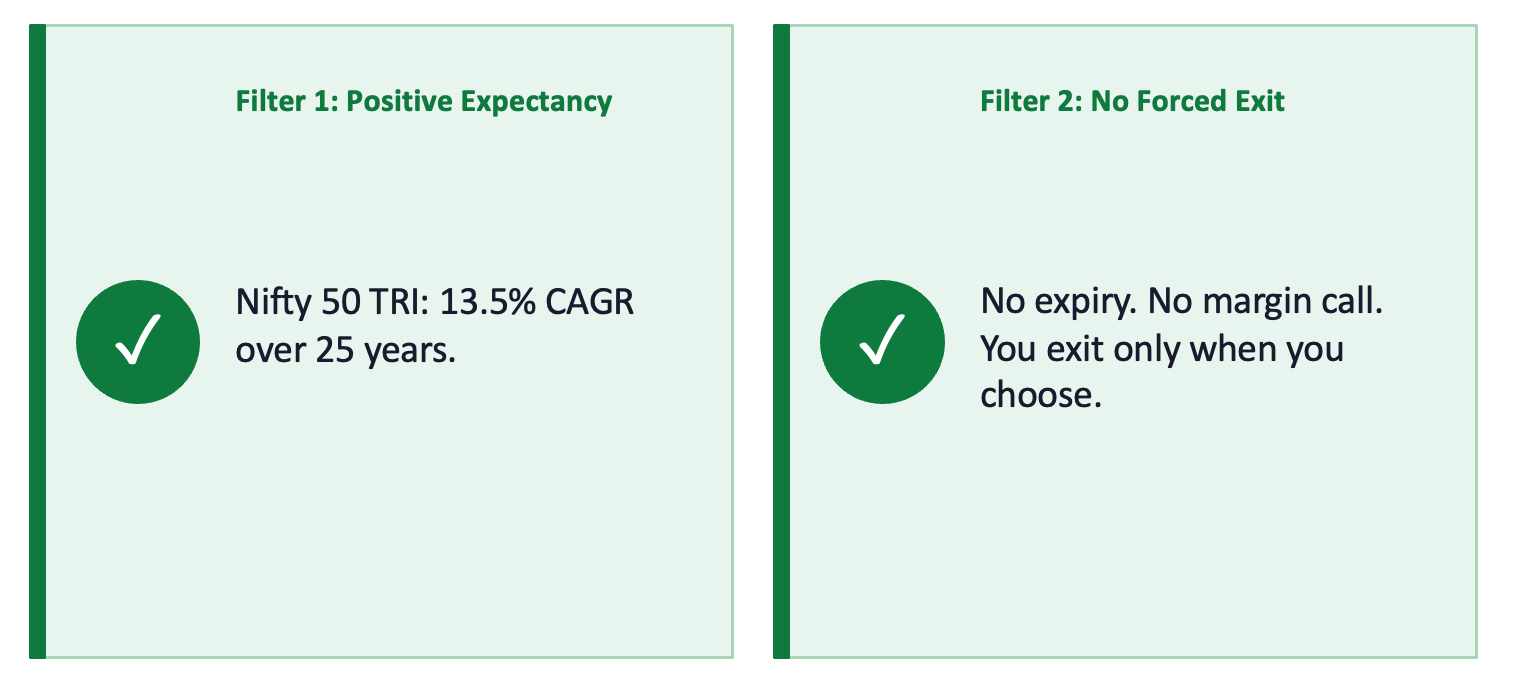
On Filter 1, the Nifty 50 TRI has delivered a 13.5% CAGR over 25 years. This is before stock selection, before any active strategy. Just being in the market has positive expectancy. Add a disciplined stock selection framework and that expectancy improves further.
On Filter 2, no one can force you out of a position. Once you hold a stock, it is legally yours. No expiry, no margin call, no auto-squareoff. You exit only when you choose to.
The edge in this game is time in the market and compounding. The dominant players are FIIs, DIIs, mutual funds, and long-term retail investors. Retail can replicate the one thing that creates an edge here: patience.
Strong Hand #2: Positional Trading
Positional trading is buying a stock and holding it for a few weeks to a few months.
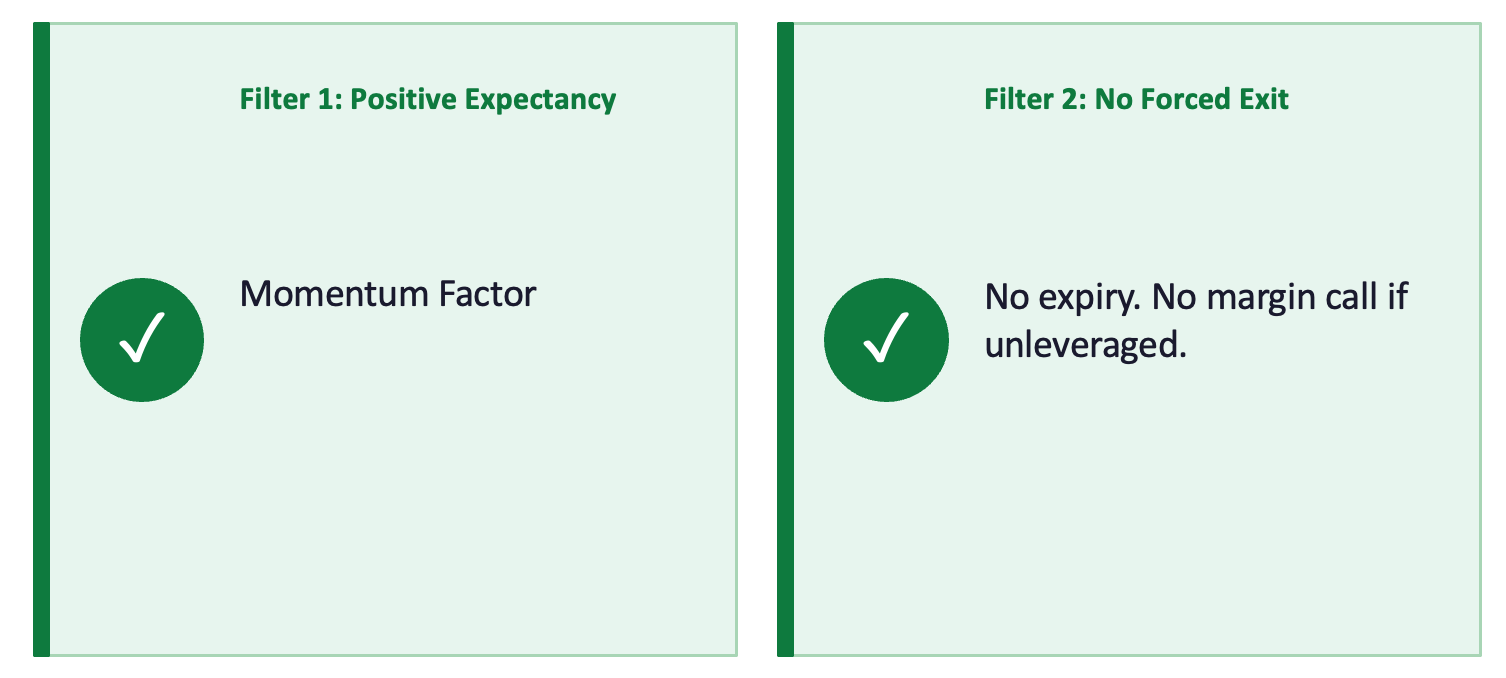
On Filter 1, this game has positive expectancy. The momentum factor is well-documented across decades of market research. Multiple multi-factor models have also proven to perform well over longer time horizons.
On Filter 2, there are no forced exits as long as you are trading unleveraged. You own the stock outright. No expiry date, no margin call. Your system triggers the exit, not your broker.
The edge here is trend identification and thesis discipline. Execution matters less than strategy. The dominant players are systematic funds and disciplined, experienced retail traders. That last category is one you can belong to.
Strong Hand #3: Hedged Options Selling
One of the popular ways of hedged option selling is executing a spread. For example, selling a put option while simultaneously buying a put option at a lower strike as a hedge. The loss is defined upfront. There is no unlimited downside like naked options selling.
The primary purpose here is to capture theta decay. The position earns money as time passes, assuming the market does not move aggressively against you.
On Filter 1, this strategy has positive expectancy when executed systematically. The theta you collect must exceed the net cost of the spread over time. When structured properly, it does.
On Filter 2, there are no forced exits. Because the loss is already capped by the hedge, there are no margin call risks. You can hold the position till expiry without any forced intervention.
One important condition: this game should be played by pledging your long-term investments, not by putting fresh cash at risk. At least 70% of your portfolio should be in long-term holdings first. Then you pledge those holdings and deploy hedged options selling on the margin.
Strong Hand #4: Portfolio Hedging
Portfolio hedging applies to retail investors who have built a portfolio of at least 15 to 20 lakhs.
By putting systematic hedges in place, you can protect your portfolio from large drawdowns during crashes.
Good hedges limit drawdowns to manageable levels during 30 to 40% market crashes. Some hedging structures are what I call zero-loss strategies, where the cost of the hedge is recovered regardless of market direction. More advanced setups can be structured so both the portfolio and the hedge are profitable over time.
The Scorecard
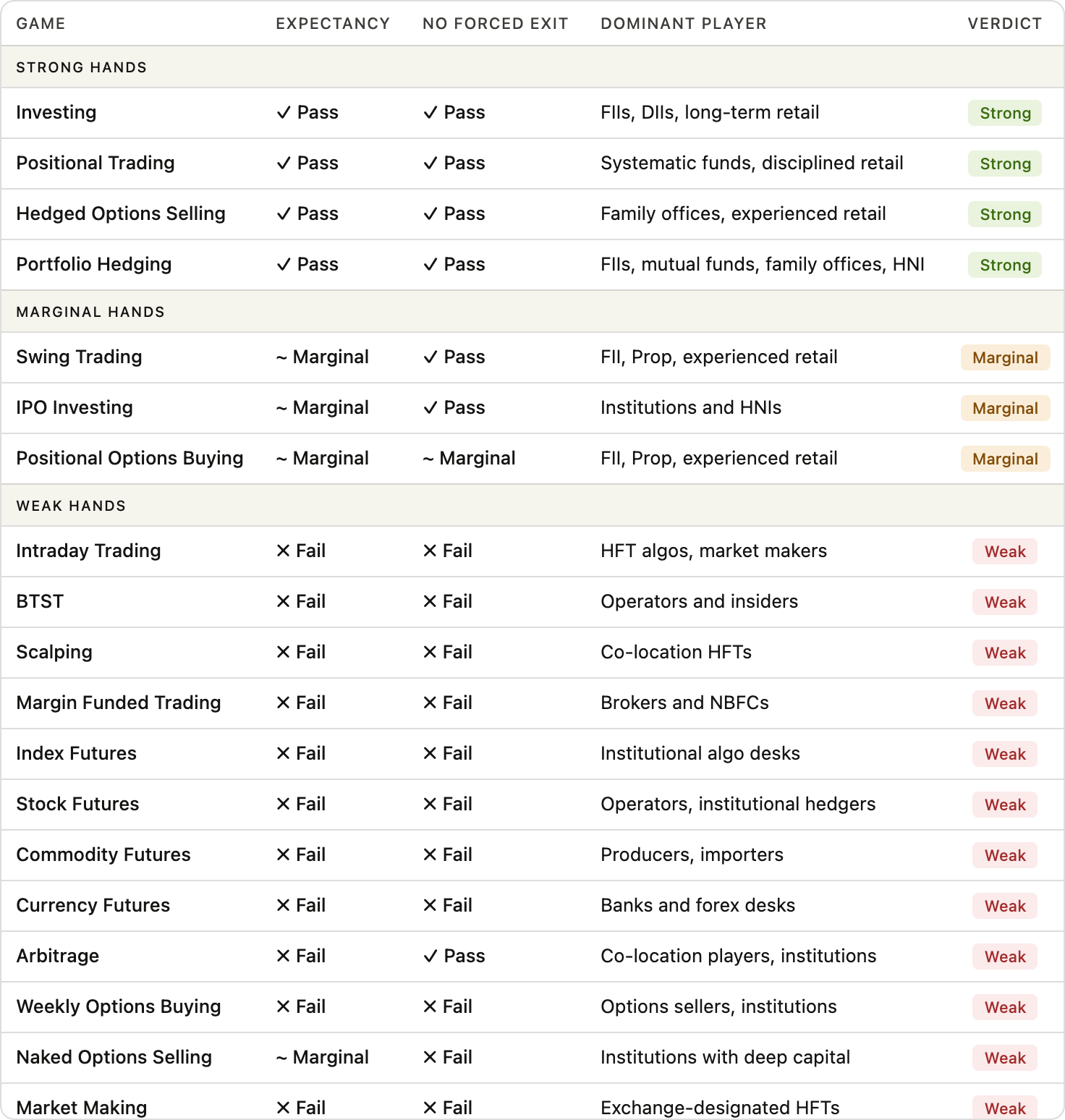
The table below summarizes all games. 4 games are strong hands that you should be playing. 3 are marginal. 13 are weak hands that you should avoid as Retail.
A few notes on the marginal zone.
Swing trading, which is holding for a few days, has some edge on paper. But in practice, if you execute 300 to 400 trades a year as swing traders typically do, transaction costs consume a large portion of the theoretical edge. Investing and positional trading achieve better outcomes with far fewer trades.
Positional options buying can work in a discretionary manner, specifically when you identify that a particular trend is strong enough to justify the options premium cost. Doing it systematically, week after week, does not hold up. The expectancy drops when done frequently.
IPO investing has some edge during certain market cycles but the dominant players are institutions and HNIs who get preferential allocations. Retail gets the scraps.
What You Should Play
Four games. That is it.
Invest in quality businesses and hold for the long term. Index Investing with proper Asset Allocation should do.
Add positional trading once you have a systematic approach to trend identification.
Layer in hedged options selling by pledging your investments once your portfolio is meaningful.
Add portfolio hedging once you cross 15 to 20 lakhs.
Everything else, intraday trading, BTST, scalping, margin trading, futures, weekly options buying, naked options selling, is either structurally stacked against you or dominated by players you cannot compete with.
The broker is the guaranteed winner in the weak hand games. They charge interest on leveraged positions, collect brokerage on every trade, and are probably making market and extracting value from the other side of your trades.
Stick to the 4 strong hands. That is enough to do very well over time.
FINVEZTO.COM | Build Wealth. With Clarity.
I give you a Flexi-Wealth System and In-Depth Research to build a Life-Long Portfolio that works across market cycles.
Disclaimer: Anand Ganapathy K is a SEBI-registered Research Analyst with SEBI registration number INH000016630. This post is purely for learning purposes. I do not recommend buying or selling stocks mentioned in this newsletter. I do not hold any positions in the stock discussed. Securities market investments carry market risks. Kindly review all related documents before investing.
Miracle
beautifully written sir 👏